
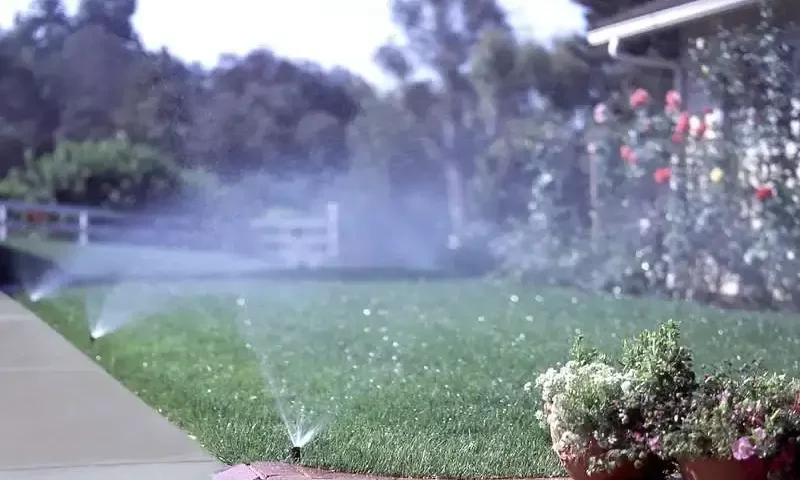
The short answer: most residential properties in the GTA need four to eight zones, and larger properties with extensive gardens need more. But the number is not chosen from lot size — it is calculated from the water pressure and flow available at the property, because that determines how many sprinkler heads can run at once at the pressure they were designed for. Too few zones is the single most common reason a system waters unevenly.
What a zone actually is
A zone is a group of sprinkler heads fed by one valve, which run together. A controller opens one valve at a time, so zones water in sequence rather than all at once. This is not a limitation of the hardware — it is the whole point. No residential water service can supply every head on a property simultaneously at proper pressure, so the property is divided into groups small enough to be watered properly one after another.
How the number is worked out
Two measurements decide it, and both have to be taken at your property:
- Static pressure — the pressure in the line with nothing running, measured in psi.
- Available flow — how much water the service can actually deliver, measured in gallons per minute.
Every sprinkler head has a known flow requirement at a given pressure. Add up the heads you want on one valve, and if their combined requirement exceeds what the service can deliver, every head on that zone runs under-pressured. So the arithmetic runs: measure what is available, then group heads into zones that stay inside it. The irrigated area then tells you how many of those zones you need.
This is why two houses on the same street can need different zone counts. A larger or newer water service supports more heads per zone, which reduces the number of zones. An older, undersized service does the opposite.
What under-pressured heads look like
This is the part worth understanding, because it explains almost every complaint about poor coverage. A sprinkler head is engineered to throw a specific distance at a specific pressure, and the layout depends on each head's spray reaching the next one — coverage is designed to overlap deliberately. Starve the zone of pressure and every head throws short. The overlap disappears, and rings of dry grass appear between heads.
What makes it deceptive is that the system still looks like it is working. Water comes out of every head. The homeowner's instinct is to run it longer, which puts more water on the areas already being covered while the dry rings stay dry. The fault is the zone, not the schedule.
Why exposure matters as much as area
Even with ample water, some areas belong on separate zones because they need different amounts of water:
- Sun and shade. A front lawn under a mature street tree canopy dries far more slowly than an open rear yard. Watered on one schedule, one of the two is always wrong — and in Toronto, with its heavy street-tree canopy, this is the most common zoning mistake we find.
- Lawn and garden beds. Beds want a slower, deeper soak than turf. A system from Pro Green can be designed to water both gardens and grass, so where it makes sense we design for both — but they are zoned separately.
- Slopes. A sloped area needs shorter, repeated cycles so water soaks in rather than running to the bottom of the yard. That only works if the slope has its own zone.
- Different head types. Rotors and spray heads apply water at very different rates and must never share a zone — whatever run time suits one is wrong for the other.
Rough expectations by property type
With the caveat that only a measurement at the property settles it:
- Compact city lot (small front lawn, modest rear): often three to four zones.
- Typical subdivision lot, 40 to 60 foot frontage: commonly four to six.
- Wide frontage, as in much of North York and Bayview Village: six to eight, with the front often split into two or three on its own.
- Large property with extensive gardens: eight or more, frequently with a controller chosen for station count and a master valve.
Why quotes differ — and what to ask
Dropping a zone is the quickest way to make a quote cheaper, and it is invisible at the point of sale. The system will run. It will pass a walkthrough in May. It will disappoint in August. If you are comparing quotes, two questions settle it quickly: what static pressure and flow did you measure at my property? and how many zones, and what is on each one? A contractor who measured will answer immediately.
Adding a zone later is possible but more expensive than doing it correctly at installation, because it means returning to opened ground and re-working a manifold that was not sized for it.
Rotors and spray heads cannot share a zone
This is worth its own section because it is a mistake we still find on systems installed by others, and it cannot be fixed by programming. A rotor throws a single rotating stream over a long distance and applies water slowly. A spray head covers a smaller area in a fixed fan and applies water several times faster. Put both on one valve and whatever run time you choose is wrong for one of them — either the rotor area is left dry or the spray area is flooded.
They are separated at the design stage, which is part of why a property with both open lawn and tighter planted areas needs more zones than its square footage alone suggests. On most GTA properties we use rotors for open lawn and spray heads for tighter areas and beds.
Ask for a zone chart
When a system is commissioned you should end up knowing which zone covers which part of the property. It sounds like a formality until the first time a zone misbehaves in July: if you can tell the office "zone four, the front right" rather than "somewhere near the driveway", the visit is shorter and the diagnosis is better. We walk through it at handover, and again at the spring start-up if you want a refresher.
It also matters for watering properly. Once you know that zone two is the shaded front and zone five is the open back, adjusting run times stops being guesswork — see our month-by-month watering guide for what each should actually be getting.
One note on servicing: we happily service, repair, start up, maintain and winterize our existing clients' systems across the GTA. If you have a system installed by someone else and are only looking for seasonal maintenance, that is usually something we cannot take on. If an existing system needs upgrading or significant modification, we may be able to help — give the office a call and we will tell you straight away.
For installed costs see the 2026 cost guide, and for how zone counts play out on local property types try the North York, Forest Hill or Leaside pages. The irrigation and sprinkler systems page explains how the systems themselves are built.
Want a system designed for your property? We walk the property with you and put the quote in writing. Book a free on-site quote.
Ready for a Pro Green sprinkler system on your property?
Get a free on-site walkthrough and a written quote within a few days — no obligation.
Get a Free Quote →