
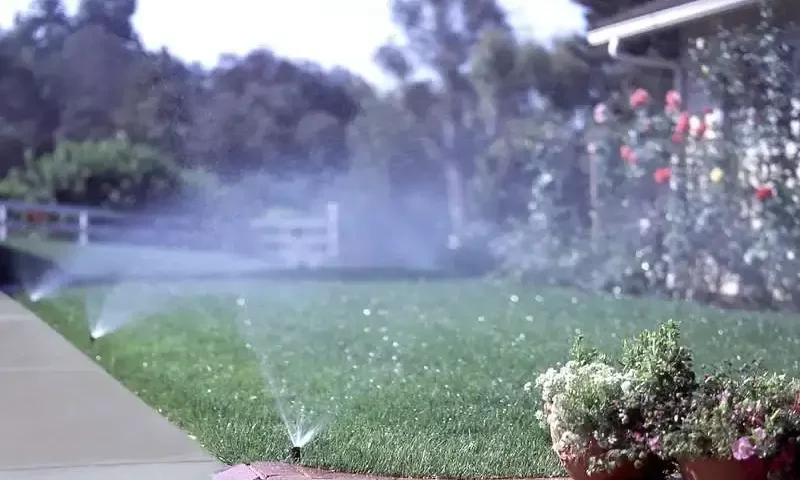
The short answer: book a spring start-up for April, once the risk of a hard frost has passed. A proper start-up is not just opening the valve — it covers charging the system slowly, checking and adjusting every sprinkler head, testing each zone, and programming the controller for the season ahead. Skipping it, or doing only the water-on part, is how a system quietly waters badly for an entire summer.
Why the system cannot simply be switched on
A system that has spent five months empty and under air is not in the same condition it was in October. Over winter, seals dry out, heads settle in thawing ground, mowing from last season has left some heads sitting low, and ground movement can shift a sprinkler out of plumb so it sprays sideways. Charging all of that at full pressure in one go is also hard on the system — a sudden surge of water into empty pipe is exactly the kind of shock that finds any weakness winter has left behind.
So the first thing a start-up does is bring the system up to pressure gradually, with the zones open, so air is pushed out ahead of the water rather than compressed in front of it.
What a proper start-up covers
- Charging the system gradually, letting air out through the heads rather than slamming empty pipe with full pressure.
- Running every zone and watching it run — which is the only way to find a head that is blocked, broken, sunken or aimed into a fence.
- Checking each head's height and plumb. Heads that have settled low spray into the grass instead of across it, which is one of the most common causes of a dry patch.
- Adjusting arcs and nozzles so coverage reaches what it should and stops at the property line, rather than watering the sidewalk or the neighbour's walk.
- Inspecting the valve manifold for weeping or seepage that points to winter damage.
- Testing the rain sensor, which is cheap, easy to forget, and useless once it has failed.
- Programming the controller for the season — run times and frequency suited to spring, not a schedule left over from last August.
- Walking you through anything that needs attention, with a recommendation rather than a surprise.
When to book it in the GTA
April, in most years. The constraint is not the calendar date but the risk of a hard overnight frost: charge a system while a freeze is still possible and you put water back into lines that may freeze again. Across the GTA that risk fades through April, a little earlier close to the lake and a little later north of Highway 7.
There is no advantage to being first. A lawn coming out of a Toronto winter has plenty of moisture in the ground, and most properties do not need irrigation at all until the weather turns dry in May. Starting the system in March does nothing for the lawn and carries real risk.
The problems a start-up catches
Most of what we find in spring is small, cheap to correct, and expensive to ignore for a season:
- Heads sitting below grade after a season of mowing and settling — the single most common finding.
- Blocked nozzles from grit that worked into the line over winter.
- Winter freeze damage at valve bodies and low points, found deliberately at low pressure rather than discovered at full pressure.
- Coverage lost to growth. Planting that has grown in now blocks a head that used to clear it, so the area behind it gets nothing.
- Controllers still running last year's schedule, often one written for a heat wave.
- Failed rain sensors, which means the system waters through a downpour all summer.
None of those announce themselves. A system with three heads sitting low and a failed rain sensor runs perfectly happily — it just wastes water and leaves dry patches that get blamed on the grass.
How long a start-up takes, and what it costs
On a typical residential system with four to six zones, a start-up takes roughly 45 minutes to an hour and a half. Larger properties with eight or more zones, or systems with extensive garden coverage, take longer simply because every head has to be looked at while its zone runs — there is no shortcut that preserves the value of the visit.
Start-ups are priced as a seasonal service visit rather than per hour, and they are bundled with the fall blow-out in our prepaid packages, which works out cheaper than booking the two separately. Parts, if something needs replacing, are quoted before anything is done — we do not fit parts and present the bill afterwards.
Why the first cycle is worth watching with us
If you can be home for the start-up, the most useful fifteen minutes of your year are spent walking the property while the zones run. You find out which head covers which part of the lawn, what the coverage is supposed to look like when it is right, and where the valve boxes are. When something changes in July, you then know whether what you are seeing is normal.
It is also the moment to raise anything from last season. A corner that always browned off, a patch that stayed soggy, a head you clipped with the mower — those are the observations that turn a routine visit into a fix, and they are much harder to diagnose in August from a description over the phone.
Should the schedule be set for April or for summer?
For April. A lawn coming out of a GTA winter has moisture in the ground and cool nights, and it needs very little supplemental water through late April and early May. A schedule written for July heat and left running from April produces soft, shallow-rooted growth that then struggles in the first real dry spell.
The sensible approach is a light spring program, stepped up as the weather turns. A Wi-Fi controller does this automatically against local forecast data; a conventional controller needs adjusting once or twice through the season, which is part of what a mid-season tune-up covers. Our month-by-month watering guide sets out what each part of the season actually calls for.
Start-up and winterization as a pair
These two visits are the whole maintenance requirement for a well-installed system: a start-up in spring and a blow-out in fall. Our prepaid service packages bundle them, add mid-season tune-ups at the higher tiers, and get scheduled ahead of one-off requests — which matters more in the fall rush than in spring.
One note on servicing: we happily service, repair, start up, maintain and winterize our existing clients' systems across the GTA. If you have a system installed by someone else and are only looking for seasonal maintenance, that is usually something we cannot take on. If an existing system needs upgrading or significant modification, we may be able to help — give the office a call and we will tell you straight away.
What you can do yourself before we arrive
Two things genuinely help. First, walk the property and note anything you noticed last season — a dry corner, a soggy patch, a head that looked wrong. Those observations are more useful than they sound, because you have watched the lawn for months and we have not. Second, clear anything stacked over a valve box or a head so it can be reached.
For how we approach properties in your area, see the Toronto, Etobicoke or Markham pages, and the FAQ page for shorter answers to common questions.
Want a system designed for your property? We walk the property with you and put the quote in writing. Book a free on-site quote.
Ready for a Pro Green sprinkler system on your property?
Get a free on-site walkthrough and a written quote within a few days — no obligation.
Get a Free Quote →