
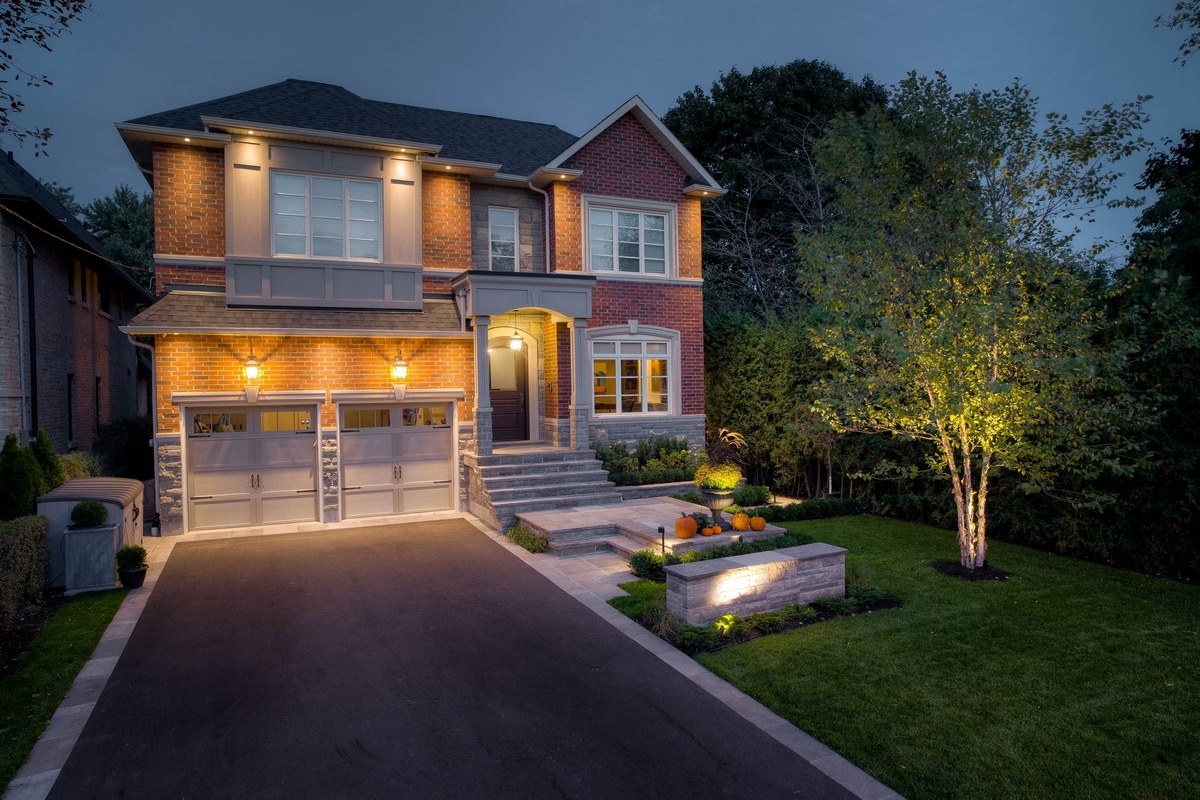
The short answer: landscape lighting is priced per fixture plus the transformer and wiring, so the cost of a scheme is driven by how many fixtures it takes to light what you actually want lit — not by the size of the property. A front elevation with two trees and a walk is a modest job. An estate frontage with a driveway, specimen trees, stonework and a rear garden is a much larger one. Pro Green quotes after walking the property at dusk, because that is the only way to see what the lighting has to do.
We do not publish a price range for lighting, and you should be wary of anyone who does without seeing the property. What we can do is set out exactly what moves the number, so you can read a quote properly.
What you are actually paying for
- Fixtures. The visible part, and the biggest single variable. Contractor-grade fixtures — we use Vista among others — are cast brass or copper rather than painted aluminium, carry real warranties, and survive being hit by a snow shovel. The cheap ones photograph identically on day one and look quite different in year three.
- The transformer. One per system in most cases, sized for the total load with headroom for additions. Undersizing the transformer to save money is a false economy, because it caps what you can add later.
- Wire and its routing. Low-voltage cable, buried, in gauges chosen for the run length. Long runs to the back of a property need heavier wire to avoid voltage drop — which is why a far-flung fixture costs more than one by the front door.
- Labour, including the design. Deciding where light goes, and at what intensity, is most of the craft. A well-designed six-fixture scheme beats a badly designed fifteen-fixture one.
- Controls. A timer or photocell at minimum, so the system runs without anyone thinking about it.
The six things that change the number most
1. How many features you want lit
This is the honest answer to "what does lighting cost": it depends what you want to see. Walk the property at dusk and count what you actually want lit — the specimen maple, the stone pillars, the front steps, the path to the gate. Each one is a fixture or two. That count, more than anything else, is your budget.
2. Front only, or front and back
Most homeowners start with the front elevation, because that is what is seen from the street and what does the most for the house. Rear gardens are where lighting gets used in the evening, and they often want more fixtures at lower intensity. Doing both at once is cheaper than doing them in two visits.
3. Distance from the transformer
A fixture at the end of a long rear garden needs a heavier cable run than one on the front walk. On larger properties this is a real cost, and it is a reason to plan the whole scheme up front even if it is installed in phases.
4. What is in the way
Cable has to get from the transformer to each fixture. Established beds, mature root systems, interlock, stonework and driveways all affect how that is done. None of it is an obstacle, but some of it is slower.
5. Fixture type
Uplights for trees and elevations, path lights for walks and steps, well lights where a fixture must sit flush, and wash lights for broad surfaces are all different items at different prices. A scheme is normally a mix, chosen for the job rather than for uniformity.
6. Whether it goes in with irrigation
This one can save you real money. Because the same crews install both, adding lighting while a sprinkler system is going in means one mobilisation, one set of cable routes planned alongside the pipe, and ground that is already being worked. Most of our clients who have both had them installed together.
Why 12V low-voltage, and what it saves
Line-voltage lighting runs at household current; low-voltage systems step it down to 12V at the transformer. The practical consequences all favour low voltage for residential work: it is safer to work around and to adjust, cable requirements are lighter, fixtures can be moved as a garden grows without rewiring, and running cost is modest. Our low-voltage page goes into the comparison in more detail.
Running cost deserves a word. A modern LED landscape scheme draws very little — the whole system is typically comparable to a few household bulbs, running only between dusk and whatever hour you choose. Lighting is not where an electricity bill goes.
Where to spend first, if the budget is finite
Almost every scheme is phased in practice, so the order matters. From what we see delivers the most for the money:
- The front elevation. Lighting the face of the house — brick, stone, the entry — changes the property's appearance from the street more than anything else, and it is what visitors and passers-by see.
- One or two specimen trees. A mature tree uplit from below is the single most striking element in most residential schemes, and it is two fixtures.
- The walk and the steps. This is the safety item. Graded light along the path to the door, and on any change of level, is the part of a scheme that earns its keep every single night.
- The driveway on longer frontages, where it also helps with reversing after dark.
- The rear garden last — not because it matters least, but because it is where the fixture count grows fastest, so it benefits most from being planned as its own phase.
If the whole scheme is designed up front and installed in phases, the transformer and the main cable runs are sized once for the finished system. Adding later then costs only the fixtures and a short run, instead of reworking the infrastructure.
What a cheap lighting quote leaves out
- No dusk visit. Lighting designed in daylight is guesswork. What matters is what the property looks like after dark.
- Painted aluminium fixtures that corrode and fade. Ask what the housings are made of.
- An undersized transformer with no capacity to add anything later.
- Wire too light for the run, which shows up as dim fixtures at the far end of the system.
- No aiming visit. Fixtures need adjusting after dark once installed. A scheme that was never aimed properly lights the wall above the tree.
- No warranty in writing on fixtures or on labour.
Maintenance, and how lighting ages
A low-voltage system is undemanding but not maintenance-free. Fixtures get knocked out of aim by snow clearing and by people, lenses need occasional cleaning, and planting grows in front of lights that used to clear it — a shrub that has thickened over three seasons will block an uplight entirely. Re-aiming and a clean restores more than people expect. LED lamps last for years but not forever.
Because the fixtures are solid brass and the system is low voltage, the parts that fail are usually the cheap ones, and the scheme itself keeps working for a long time. The benefits page covers what it does for the property; the lighting gallery shows finished schemes.
How to get a number for your property
Walk the property at dusk, note what you would like lit, and get a quote based on that list. We will tell you which parts give the biggest effect for the money — usually the front elevation and the trees before anything else — and what is better left to a later phase. The quote is in writing after the visit.
Want this costed for your own property? We walk the property with you and put the quote in writing, with no obligation. Book a free on-site quote.
Ready for a Pro Green sprinkler system on your property?
Get a free on-site walkthrough and a written quote within a few days — no obligation.
Get a Free Quote →