
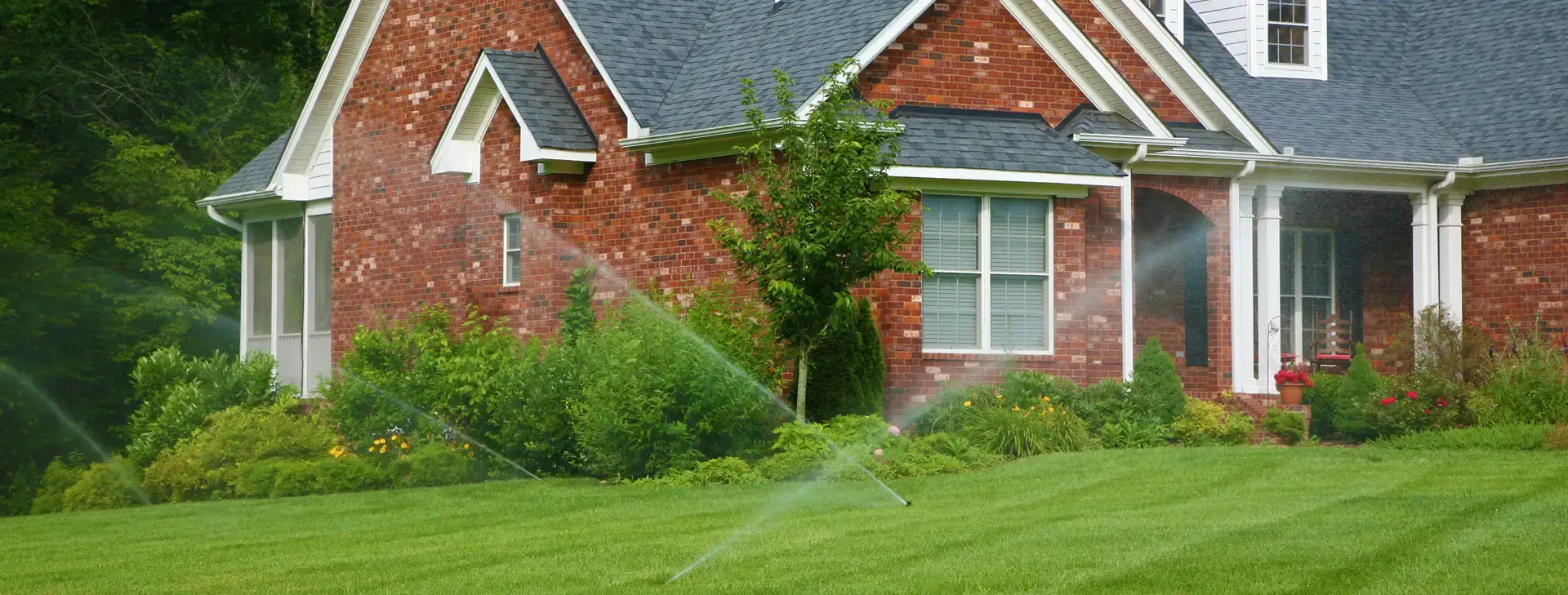
The short answer: a Toronto lawn generally wants about one inch of water a week including rainfall, delivered in two or three deep sessions rather than a little every day, and applied between 4 AM and 7 AM. Deep and infrequent beats shallow and frequent at almost every point in the season, because it drives roots down instead of keeping them at the surface.
Why deep and infrequent wins
Grass roots grow toward water. Water lightly every day and the roots have no reason to go deeper than the top few centimetres, which leaves the lawn completely dependent on the next watering and the first to suffer in a dry spell. Water deeply but less often and the moisture penetrates, the roots follow it down, and the lawn becomes far more tolerant of heat and of a missed cycle.
A deeper root system also competes better with weeds and recovers faster from wear. Most of the difference between two lawns on the same street is watering habit rather than seed or fertiliser.
Why the early morning matters so much
Watering between 4 AM and 7 AM is the single biggest efficiency improvement most homeowners can make, for three reasons: wind speeds are at their lowest so less spray drifts off target, temperatures are cool so less evaporates before it reaches the soil, and the foliage has the whole day to dry, which sharply reduces fungal disease pressure.
Watering in the afternoon loses a meaningful share to evaporation. Watering in the evening leaves grass wet overnight, which is how lawn disease gets established. A controller handles the early window without anyone losing sleep, and a Wi-Fi controller will also skip a cycle when the forecast says rain is coming.
A month-by-month guide for the GTA
- April — usually no irrigation needed. The ground is still carrying winter moisture. This is the month for the spring start-up, not for watering.
- May — light use. Often one session a week, and only once the weather turns dry. Over-watering in May produces lush, shallow-rooted growth that then struggles in July.
- June — two sessions a week on most properties as temperatures climb.
- July and August — the peak. Two to three deep sessions a week, keeping the weekly total around an inch. This is when under-zoned systems and poor coverage become obvious.
- September — taper back as nights cool and rainfall returns. Often back to one or two sessions.
- October — usually nothing, and time to book the fall blow-out.
Treat that as a starting point rather than a prescription. A week of rain replaces a week of irrigation, which is exactly what a rain sensor or a weather-based controller is for.
Adjusting for your own soil
Soil type changes how the same inch of water behaves, and it varies across the GTA:
- Clay, which underlies much of Toronto and York Region, accepts water slowly. Apply it too fast and most runs down the driveway. The fix is cycle-and-soak: two or three shorter run times separated by a gap, rather than one long pass. Clay then holds moisture well, so sessions can be less frequent.
- Sandier ground, more common closer to Lake Ontario, takes water readily but drains fast and dries out sooner in midsummer. Shorter, more frequent sessions suit it better.
- Sloped ground behaves like clay regardless of soil, because water leaves before it can soak in. Slopes need their own zone and shorter cycles.
How to tell whether you are getting it right
Three checks, none of which need equipment:
- The screwdriver test. A few hours after a cycle, push a long screwdriver into the lawn. If it goes in easily to about 15 cm, the water has penetrated. If it stops short, you are watering shallowly.
- Footprints. Grass that holds a footprint rather than springing back is short of water.
- Colour change at the edges first. If the far corner of a zone fades before the rest, that is a coverage problem, not a schedule problem — see how many zones a lawn needs.
To measure what you are actually applying, put a few straight-sided containers on the lawn, run one zone for fifteen minutes, and measure the depth collected. That tells you both the application rate and how evenly the zone covers — if one container has twice what another does, the layout needs attention.
Watering new sod or a newly seeded lawn
New turf is the one case where the deep-and-infrequent rule is reversed. New sod has no root system to reach down with, so it needs light, frequent watering — often twice a day for the first week or two — to keep the top few centimetres damp while the roots knit into the soil beneath. Seed is similar: the seed bed must not dry out.
Then you taper deliberately. Over the following month, water less often but for longer each time, which teaches the new roots to follow the moisture down. By about six weeks a new lawn should be on the normal schedule. Staying on the frequent-and-shallow pattern is one of the most common reasons a beautiful new lawn struggles in its first real summer.
Garden beds are not on the same schedule
Beds and lawn want water applied differently — beds a slower, deeper soak at the roots, turf a shorter heavier cycle across the surface. A system from Pro Green can be designed to water both gardens and grass, so where it makes sense we try to design a system that can water both. Ask us about options for your property.
The practical consequence for scheduling is that beds generally need watering less often than lawn but for longer, and established shrubs and trees need far less than either once they are properly rooted.
What over-watering looks like
It is at least as common as under-watering on automated systems, and more expensive, because it wastes water and invites disease. The signs are worth knowing:
- Spongy ground that stays soft for a day or more after a cycle.
- Mushrooms or fungal patches, especially in shade — usually a sign the shaded zone is on the sunny zone's schedule.
- Shallow, pale growth that wilts quickly in heat despite frequent watering.
- Runoff onto the driveway or the sidewalk during a cycle, which means water is being applied faster than the soil can take it.
- Moss establishing in damp, shaded areas.
If you see runoff, the fix is not a shorter total — it is splitting the same total into two or three shorter cycles with a gap between them.
Watering restrictions and good practice
Municipal rules on outdoor water use vary across the GTA and can change from season to season, so check your own municipality's current guidance — the City of Toronto publishes its water and sewer information online. Early-morning, deep, infrequent watering sits comfortably inside normal practice everywhere in the region and uses less water than a hose left running in the afternoon.
For local soil and pressure specifics, the Toronto, Mississauga and Richmond Hill pages go into what we find on properties in each area.
Want a system designed for your property? We walk the property with you and put the quote in writing. Book a free on-site quote.
Ready for a Pro Green sprinkler system on your property?
Get a free on-site walkthrough and a written quote within a few days — no obligation.
Get a Free Quote →