
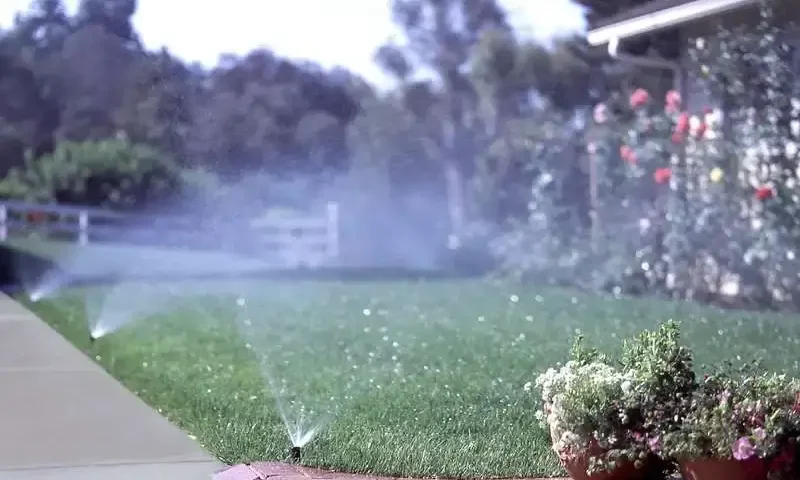
The first question almost every homeowner asks us is also the hardest one to answer over the phone: what does an inground sprinkler system cost? The honest answer is that it depends on the property — but "it depends" is useless on its own, so this guide sets out the real numbers we quote in Toronto, what sits inside them, and which features of a property actually move the price.
What a sprinkler system costs in Toronto in 2026
For a typical Toronto subdivision lot — roughly a 40 to 60 foot frontage with 100 to 150 feet of depth — a complete Pro Green inground system is generally in the range of $3,900 to $4,900. That is a fully installed, fully commissioned system: design, materials, labour, programming, and our five-year parts and labour warranty.
Above and below that range, properties diverge quickly. A compact midtown lot with a small front lawn and a modest rear garden can come in under it, because it needs fewer zones. A larger property with extensive gardens, mature trees and a long frontage will sit above it, because the irrigated area is bigger and the design needs more zones to cover it properly. Estate-sized lots are quoted individually after a site visit; there is no sensible way to price them from a street view.
What is actually included in the price
When we quote a number, it covers the whole job rather than a parts list:
- On-site design. We measure static pressure and available flow at the property, then work out how many heads each zone can carry at proper pressure. The layout is flagged out on the ground and walked through with you before anything is installed.
- Utility locates and scheduling. Arranged by us, not left to you.
- Contractor-grade components. Hunter and Rain Bird heads, valves and controllers — the same parts we have to come back and service for the next twenty years.
- Trenchless installation. Pipe is pulled beneath the turf rather than dug in, so an established lawn is walkable the same day.
- Commissioning. Every head adjusted, every arc set, the controller programmed for the season, and a walkthrough so you know how to use it.
- Five-year parts and labour warranty* on the installed system.
What it does not include is the ongoing seasonal work — the spring start-up and the fall winterization — which are priced separately and covered further down.
Six things that move the number
1. Irrigated area, and therefore zone count
Zone count is the single biggest driver of cost, and it is not a matter of taste. A zone can only run as many heads as the water service will support at the pressure those heads were designed for. Double the irrigated area and you do not get one bigger zone; you get two or three proper ones, each with its own valve and wiring. This is why two houses on the same street can be quoted differently.
2. The water service
Pressure and flow vary across Toronto by elevation and by pressure district, and the age and diameter of the service into the house matters as much as the pressure in the street. A strong service lets a zone carry more heads, which reduces zone count. An undersized or aged service does the opposite. We test rather than assume, and if the supply is the limiting factor we tell you before you spend money, not after.
3. Gardens versus open lawn
Open turf is efficient to cover. Intricate planting — borders, island beds, foundation planting, hedges — needs more heads and more careful zoning, because beds and lawn want different amounts of water. A system from Pro Green can be designed to water both gardens and grass, so where it makes sense we try to design a system that can water both. Ask us about options for your property.
4. Slope and grade
A property that falls toward a ravine, a creek or the street needs the slope zoned separately so it can be run in shorter repeated cycles. Water applied in one long pass on a slope ends up at the bottom of the yard or on the sidewalk instead of in the root zone. That extra zone costs money up front and saves water every season afterwards.
5. Access and surfaces
Tight side passages, laneway garages, mature root systems, interlock and stonework all affect how pipe can be routed. None of it is an obstacle, but some of it is slower, and the quote reflects the hours.
6. Controller and smart features
A basic timer is inexpensive. A Wi-Fi controller that adjusts itself against local weather data, paired with a rain sensor, costs more and usually pays for itself in water. The Irrigation Association — the body through which our designers hold their Certified Irrigation Contractor certification — has long made the case that scheduling, not hardware, is where most irrigation water is won or lost. In our experience that is exactly right.
What it costs to run
Two things make up the annual cost of owning a system: water and seasonal service.
On water, most homeowners are surprised in the right direction. A zoned system applies a measured amount at the time of day when the least is lost to evaporation, which is typically between 4 AM and 7 AM. Compared with a hose or an oscillating sprinkler left running on a July afternoon, that is usually less water, not more. The City of Toronto publishes its water and sewer rates and account information if you want to put numbers to your own usage.
On service, a system in this climate needs two visits a year: a spring start-up that charges the system, checks every head, adjusts the spray patterns and programs the controller for the season, and a fall blow-out that clears the water out of the lines with compressed air. Winterization is not optional here — water left in a line will split the pipe or the fittings over winter. Our seasonal service packages set out what each visit covers.
What a cheap quote usually leaves out
Price differences between quotes are almost always explained by one of these, so it is worth asking directly:
- Too few zones. The quickest way to make a quote cheaper is to put more heads on fewer zones. The system will run, but at reduced pressure, with weak coverage at the far end of each zone — and you will not see it clearly until the first dry August.
- Sub-contracted labour. Ask who will actually be on the property. We never sub-contract; the crew is on our payroll, which is also why we are still reachable in year six.
- Residential-grade parts. Box-store heads and valves cost less and fail sooner, usually just outside whatever warranty came with them.
- No written warranty. A verbal assurance is not a warranty. Ours is five years on parts and labour, in writing.
- No on-site design. A number quoted without anyone measuring pressure at the property is a guess, and the shortfall shows up as coverage problems later.
- No credentials. Insurance, WSIB clearance and association membership are easy to ask for and quick to verify. We are members of Landscape Ontario and the CNLA, fully insured and WSIB cleared on every job.
When to book
Installations run from spring through fall, and the calendar fills from both ends. Spring is busy with start-ups for existing clients; late September through November is the heaviest stretch of our year because every system in the GTA needs winterizing before the first hard freeze. If you want a system in the ground for a particular season, the useful time to get a quote is before that season starts rather than during it.
Getting an accurate number for your property
We give written quotes after walking the property with you — frontage and depth, where the planting is, where the water service enters, what the grade does, and what you actually want watered. It takes less than an hour and there is no obligation. If you are in the city, the lawn sprinklers Toronto page covers how we work across Toronto specifically, and the irrigation and sprinkler systems page explains how the systems themselves are built.
*Warranty applies to properties within our typical service areas and typical-sized residential lots.
Ready for a Pro Green sprinkler system on your property?
Get a free on-site walkthrough and a written quote within a few days — no obligation.
Get a Free Quote →