
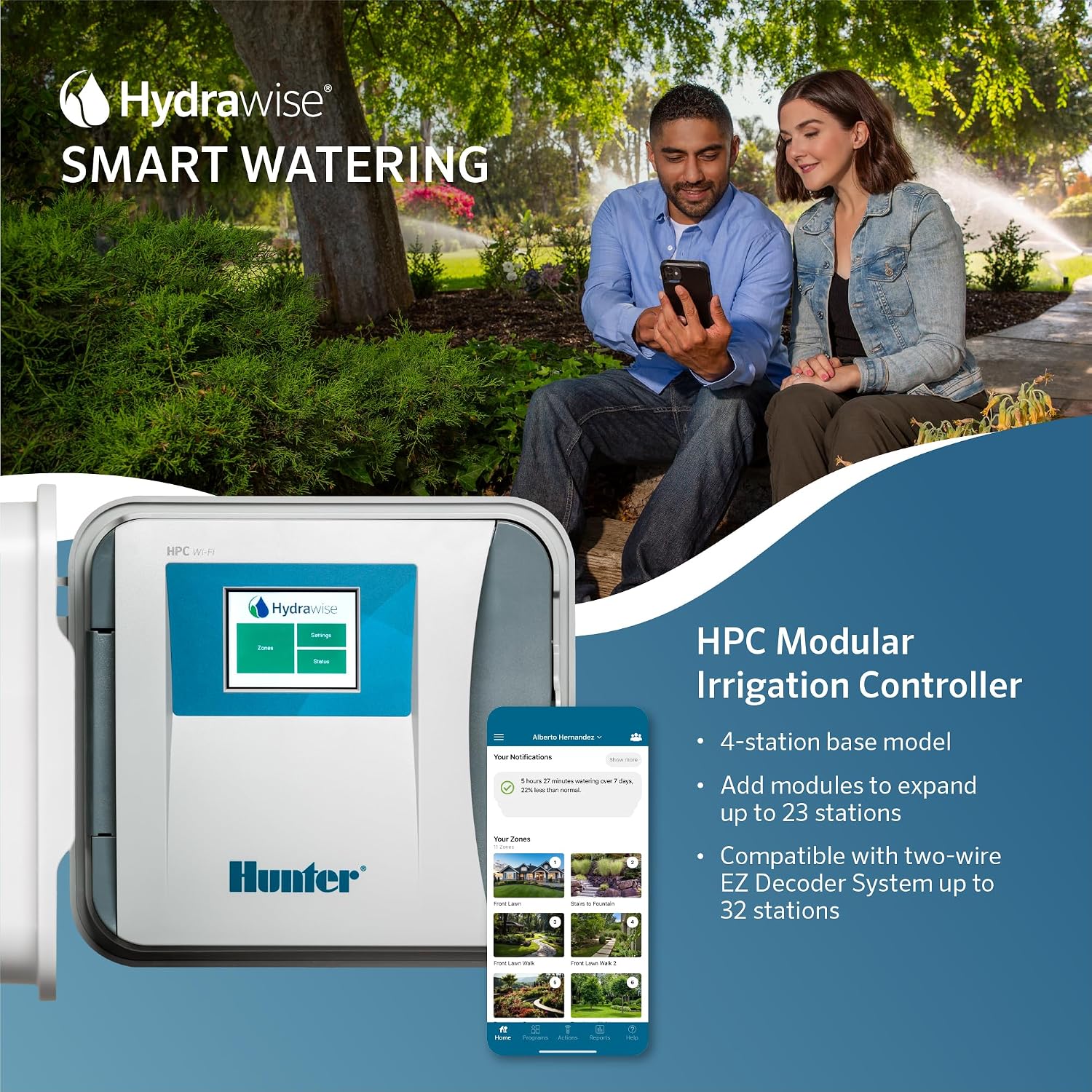
The short answer: yes, for most properties in the GTA — but the saving comes from the scheduling, not the Wi-Fi. A weather-based controller skips cycles when rain is coming, shortens them when it is cool, and lengthens them in a heat wave, which is exactly what most homeowners never do by hand. On an existing system it is usually a straight swap for the old controller, with nothing in the ground touched. If you water on a fixed timer today, this is the cheapest meaningful upgrade available to you.
What a smart controller actually does
A conventional timer does one thing: it opens each valve for however long you told it to, on the days you chose, regardless of what the weather is doing. That is why so many systems run through a downpour, and why the same schedule that was right in June starves a lawn in August.
A weather-based controller — a Hunter Hydrawise in our case — pulls local forecast and observed-weather data and adjusts:
- Skips a cycle when meaningful rain has fallen or is forecast.
- Shortens run times in cool, damp, overcast weather.
- Lengthens them through a heat wave, when a fixed schedule falls behind.
- Adjusts seasonally on its own, so April is not watered like July.
- Reports back. You can see what ran, what was skipped and why.
The second benefit is the phone app, and it is more useful than it sounds. Being able to shut the system off from the office when you notice a head geysering, or add a cycle for new sod while you are away, removes most of the reasons people end up fighting with a controller.
Where the water saving comes from
Three places, in order of size:
- Rain skips. The clearest win. Through a wet GTA spring a fixed timer waters straight through, which is pure waste. This is the saving most homeowners notice on the bill.
- Seasonal adjustment. A schedule left on July settings through September over-waters for weeks. A controller that steps itself down fixes that quietly.
- Cool-weather reductions. A cloudy week in June needs materially less water than a hot one, and almost nobody adjusts for it manually.
We are deliberately not quoting a percentage, because the honest answer depends entirely on what you do now. A homeowner who already adjusts the controller monthly and pays attention to the forecast will save relatively little. One running the same programme from May to September — which is most people — will see a real difference. Our month-by-month watering guide sets out what each part of the season actually needs, and shows how much adjustment a fixed timer never gets.
What it does for the lawn
This matters as much as the water bill, and gets discussed less. Over-watering is at least as common as under-watering on automated systems, and it causes problems rather than just costing money: spongy ground, fungal patches in shade, moss, shallow pale growth that wilts in heat, and runoff onto the driveway. A controller that waters to the weather produces deeper roots and a lawn that copes better with a dry spell, because it is not being kept permanently damp at the surface.
Will it work on my existing system?
Almost certainly, and this is the part people get wrong. A controller is the brain, not the system. Swapping it does not mean touching pipe, valves or heads — the wiring from the existing controller position moves across to the new unit. On most properties it is a short visit.
Two things to check. First, zone count: the new controller needs at least as many stations as your system has zones, and it is worth having a spare. Second, Wi-Fi coverage where the controller lives — often a garage or a basement, which can be the weakest corner of a house for signal. If it will not reach, that is solvable, but better known in advance.
What a smart controller will not fix
Worth being blunt, because this is where disappointment comes from. A controller decides when and for how long water runs. It cannot change where the water goes. So it will not fix:
- Under-zoned systems. If a zone runs more heads than the water service can supply at proper pressure, every head throws short and dry rings sit between them. No schedule fixes that — see how many zones a lawn needs.
- Heads sitting below grade after years of mowing and settling, spraying into the grass rather than over it.
- Sun and shade sharing a zone. A controller can only give that zone one run time, and it will be wrong for one of the two areas.
- Blocked nozzles, broken heads or a failed valve. Those are repairs. The troubleshooting guide covers how to tell them apart.
If a system has a coverage problem, fix the coverage first. A smart controller on a badly zoned system is a better-informed way of watering badly.
Setting one up properly
A weather-based controller is only as good as what it is told about the property, and this is where a self-installed unit usually under-performs. Three things need to be right:
- Each zone described accurately. The controller needs to know what it is watering — open sunny lawn, shaded lawn, garden beds, which head type is on the zone. Those settings are what its adjustments are calculated from, and a zone left on defaults gets generic treatment.
- The right weather station. The controller works from a nearby station; the GTA is large and conditions along the lake differ from those north of Highway 7. Picking a station that reflects your actual location matters more than people expect.
- Cycle-and-soak on clay. Most of Toronto and York Region sits on clay that accepts water slowly. A single long run — however intelligently scheduled — runs off down the driveway. The controller should be set to split each zone's watering into two or three shorter cycles with a gap between them, which is exactly the kind of thing a fixed timer is rarely configured to do.
We set all of that up at installation and revisit it at seasonal visits, because a controller configured once and never looked at again drifts out of step with a garden as the planting matures.
Rain sensors: still worth having
A weather-based controller works from forecast and station data, which is not quite the same as knowing whether rain actually landed on your property. A physical rain sensor does know, and the two complement each other. Sensors are inexpensive and fail quietly — one stuck in the "wet" position stops the system watering at all, with no fault shown — so they get tested at every spring start-up.
So should you upgrade?
Our honest view: if you have a working system on a fixed timer and you do not adjust it through the season, a weather-based controller is the single best-value improvement you can make, and it needs no work in the ground. If you are having a new system installed, have one from the start. If your system has coverage problems, spend the money on fixing those first and upgrade the controller afterwards.
The Hydrawise page covers the controllers we install and what the app does. For systems we look after, controller upgrades are usually done at a seasonal service visit rather than as a separate trip.
One note on servicing: we happily service, repair, start up, maintain and winterize our existing clients' systems across the GTA. If you have a system installed by someone else and are only looking for seasonal maintenance, that is usually something we cannot take on. If an existing system needs upgrading or significant modification, we may be able to help — give the office a call and we will tell you straight away.
Want this costed for your own property? We walk the property with you and put the quote in writing, with no obligation. Book a free on-site quote.
Ready for a Pro Green sprinkler system on your property?
Get a free on-site walkthrough and a written quote within a few days — no obligation.
Get a Free Quote →