
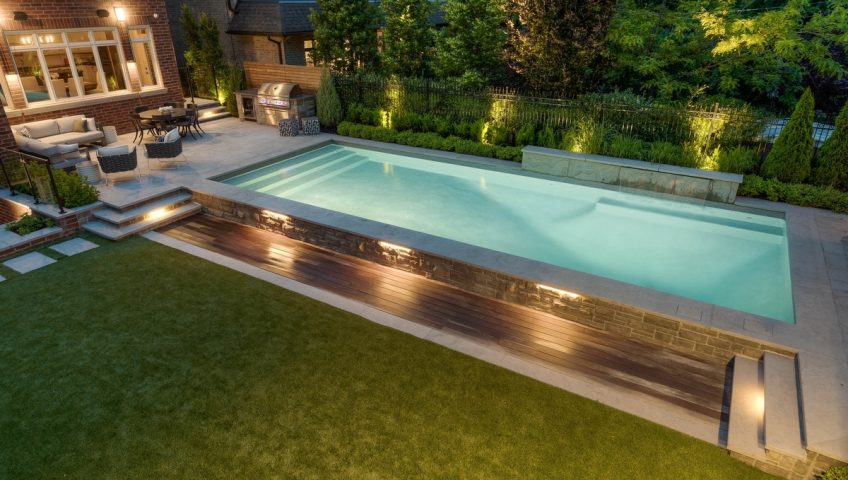
The conversation around landscape lighting has shifted in the last decade. LED fixtures and dimmable transformers have made outdoor lighting both dramatically more efficient and dramatically more capable. A well-designed system today uses a fraction of the power an equivalent setup drew ten years ago — without compromising the look.
Start with low voltage
Twelve-volt systems are not just safer near water and easier to relocate as your gardens mature — they are also more efficient. A good low-voltage transformer steps household current down once for the whole system; line-voltage installations waste power on every fixture run.
Choose LED fixtures with real lumens
Compare fixtures on lumens (light output) per watt, not just watts. A modern LED can deliver the brightness of a 35-watt halogen at 4 to 6 watts. That is not a small saving — across a 30-fixture residential install, it adds up to roughly a tenth of the running cost.
Astronomic timers
Hard-set on/off times drift as the seasons shift. An astronomic timer follows actual sunset and sunrise year-round, so the system runs only when there is darkness to light. Combined with motion sensors on security fixtures, it can cut runtime substantially.
Layer the light, dim what is decorative
Path lights at 1.5 watts, accent up-lights at 4–6 watts, and security floods (only where genuinely needed) at higher output. Most decorative fixtures look better dimmed slightly, and dimming is a direct power saving.
Maintenance keeps efficiency high
Cloudy lenses, leaf debris over fixtures, and corroded connections all eat lumens. An annual cleaning visit restores 5–10% of effective brightness in many systems, which means owners often reduce dim levels and save more power.
Ready for a Pro Green sprinkler system on your property?
Get a free on-site walkthrough and a written quote within a few days — no obligation.
Get a Free Quote →